Subterranean termite soil treatment creates a continuous chemical zone directly adjacent to the concrete perimeter or crawlspace footprint of a structure. In Central Texas, subterranean termites reside deep within…
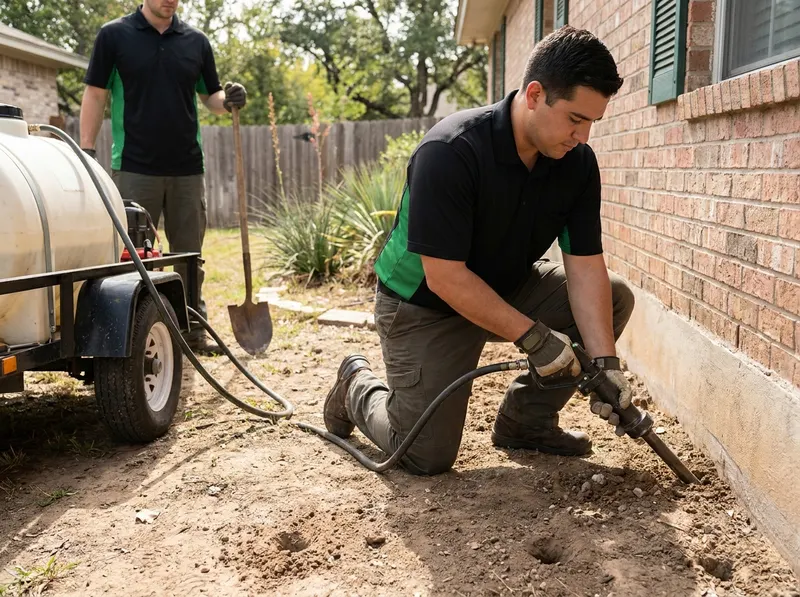
Subterranean termite soil treatment creates a continuous chemical zone directly adjacent to the concrete perimeter or crawlspace footprint of a structure. In Central Texas, subterranean termites reside deep within moist subsoils and tunnel upward to forage on residential framing lumber through earthen mud shelter tubes. Liquid soil treatment binds termiticide active ingredients to soil particles along the building perimeter. Foraging worker termites traverse the invisible barrier without detection, inadvertently collecting the compound on their cuticles and transferring it through social grooming to reproductive queens and soldier castes throughout subterranean colonies.
Foundation architecture across Austin neighborhoods dictates the specific barrier mechanics. Properties in Hyde Park, Tarrytown, and Bouldin Creek constructed on pier-and-beam foundations require individual soil trenching around every structural support pier beneath the subfloor, supplemented by exterior curtain walls. Monolithic concrete slab foundations in Mueller, Avery Ranch, and Circle C Ranch require a 6-inch by 6-inch perimeter trench excavated along exterior grade beams. Where flatwork such as driveways, covered patios, and sidewalks abut the foundation wall, technicians drill concrete access ports spaced 12 inches apart to inject termiticide into hidden sub-slab fill dirt, followed by flush mortar patching.
Local geological features significantly influence termiticide movement. The alkaline clay soils east of Interstate 35 retain chemical agents readily, requiring calibrated rod pressure to avoid pooling, whereas limestone outcroppings and fractured rock along Mount Bonnell and Zilker demand specialized pressure rigs to ensure continuous coverage through fissures. While termite baiting stations offer non-invasive monitoring along property margins, direct liquid soil applications provide immediate physical protection for properties with active indoor mud tubes, preventing structural load compromises in primary floor joists and wall studs. Treatment workflows strictly adhere to label guidelines governed by the U.S. Environmental Protection Agency and state structural guidelines set by the Texas Department of Agriculture to protect sensitive residential yards, native soil microflora, and nearby aquifers.
Every job gets a firm, written price after a free on-site visit.
For standards, safe disposal, and service guidance on pest control services in Austin, TX, useful references include U.S. EPA, ENERGY STAR, U.S. Dept. of Energy, Consumer.gov, U.S. Census Bureau, and Google Maps. General consumer and small-business resources are available from USA.gov, Better Business Bureau, FTC Consumer Advice, U.S. Small Business Administration, and Ready.gov.
Tell us about your subterranean termite soil treatment job in Austin and we'll send a clear, written quote, usually the same day.
 RiverMint Pest Solutions