Rodent structural exclusion addresses the biological drivers of native pests like the roof rat ( Journal of Integrated Pest Management ), an arboreal species that uses live oak canopies in older central Austin…
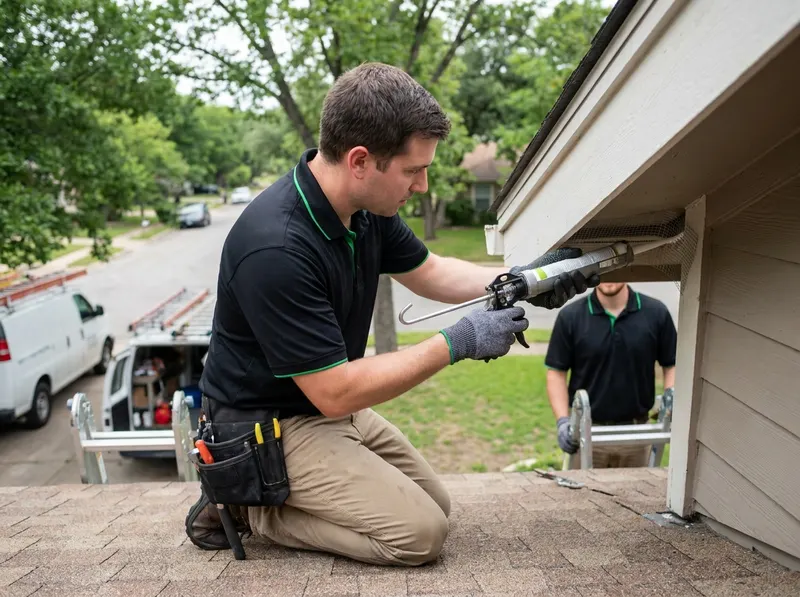
Rodent structural exclusion addresses the biological drivers of native pests like the roof rat (Journal of Integrated Pest Management), an arboreal species that uses live oak canopies in older central Austin neighborhoods like Hyde Park and Tarrytown to access structural rooflines. Because roof rats require an opening of only 0.5 inches (the diameter of a nickel) and juvenile house mice squeeze through gaps of just 0.25 inches, traditional broad-spectrum chemical sprays fail to produce durable prevention. According to guidance from the Centers for Disease Control and Prevention, mechanical seal-ups represent the most reliable initial defense against rodent-borne pathogens. RiverMint Pest Solutions avoids routine recurring poison bait stations that leave toxic carcasses inside dry-wall voids. Instead, the focus remains on non-toxic, long-lasting physical exclusion that preserves living spaces while safeguarding children and companion animals.
Technicians systematically survey the exterior building envelope, examining roof transitions, fascia boards, soffit returns, plumbing penetrations, and AC line chases. In modern slab constructions common to Mueller, Avery Ranch, and Circle C Ranch, exterior brick weep holes provide direct subterranean avenues into wall voids. We secure these vents using corrosion-resistant stainless steel weep inserts specified by the Texas A&M AgriLife Extension, maintaining necessary wall drainage and airflow without permitting rodent ingress. Along the upper perimeter, technicians attach 0.25-inch, 19-gauge hot-dipped galvanized ASTM International-rated hardware cloth and custom-bent aluminum flashing to chimney step flashings, ridge vents, and dormer junctures. This approach resists gnawing by adult rodents, which exert bite forces exceeding 7,000 pounds per square inch.
Local environmental variations throughout Austin dictate distinct exclusion methods. Properties adjacent to dense tree canopies near Zilker Metropolitan Park, Bouldin Creek, and Lady Bird Lake experience continuous arboreal rodent traffic. For these structures, tree limbs overhanging roofs within 6 feet must be pruned to eliminate natural jump points, adhering to canopy clearance guidelines from the International Society of Arboriculture. If an active population already nests within the attic, technicians install one-way exit doors or mechanical traps adhering to the National Wildlife Control Operators Association standards. These devices allow target pests to leave the envelope without re-entering. Once monitors confirm zero movement inside attic insulation, technicians close the primary evacuation threshold, test attic seals, and sanitize high-activity trails following protocols recognized by the Environmental Protection Agency and the National Pest Management Association.
Property owners face a direct operational trade-off between exterior mechanical exclusion and recurring rodenticide subscription programs. While poison subscriptions require lower initial fees, they introduce risks of secondary poisoning to non-target urban raptors documented by the Texas Parks and Wildlife Department and leave decaying pests trapped within interior framing. Physical structural exclusion carries higher upfront material and labor costs, but it provides a permanent structural barrier that eliminates recurring rodent visits. All installations conform to structural principles promoted by the International Code Council to preserve building ventilation while establishing rodent-proof defenses across Travis County.
Every job gets a firm, written price after a free on-site visit.
For standards, safe disposal, and service guidance on pest control services in Austin, TX, useful references include U.S. EPA, ENERGY STAR, U.S. Dept. of Energy, Consumer.gov, U.S. Census Bureau, and Google Maps. General consumer and small-business resources are available from USA.gov, Better Business Bureau, FTC Consumer Advice, U.S. Small Business Administration, and Ready.gov.
Tell us about your roof rat and mouse structural exclusion job in Austin and we'll send a clear, written quote, usually the same day.
 RiverMint Pest Solutions